Blue Heron

A Review by Ava Bellows
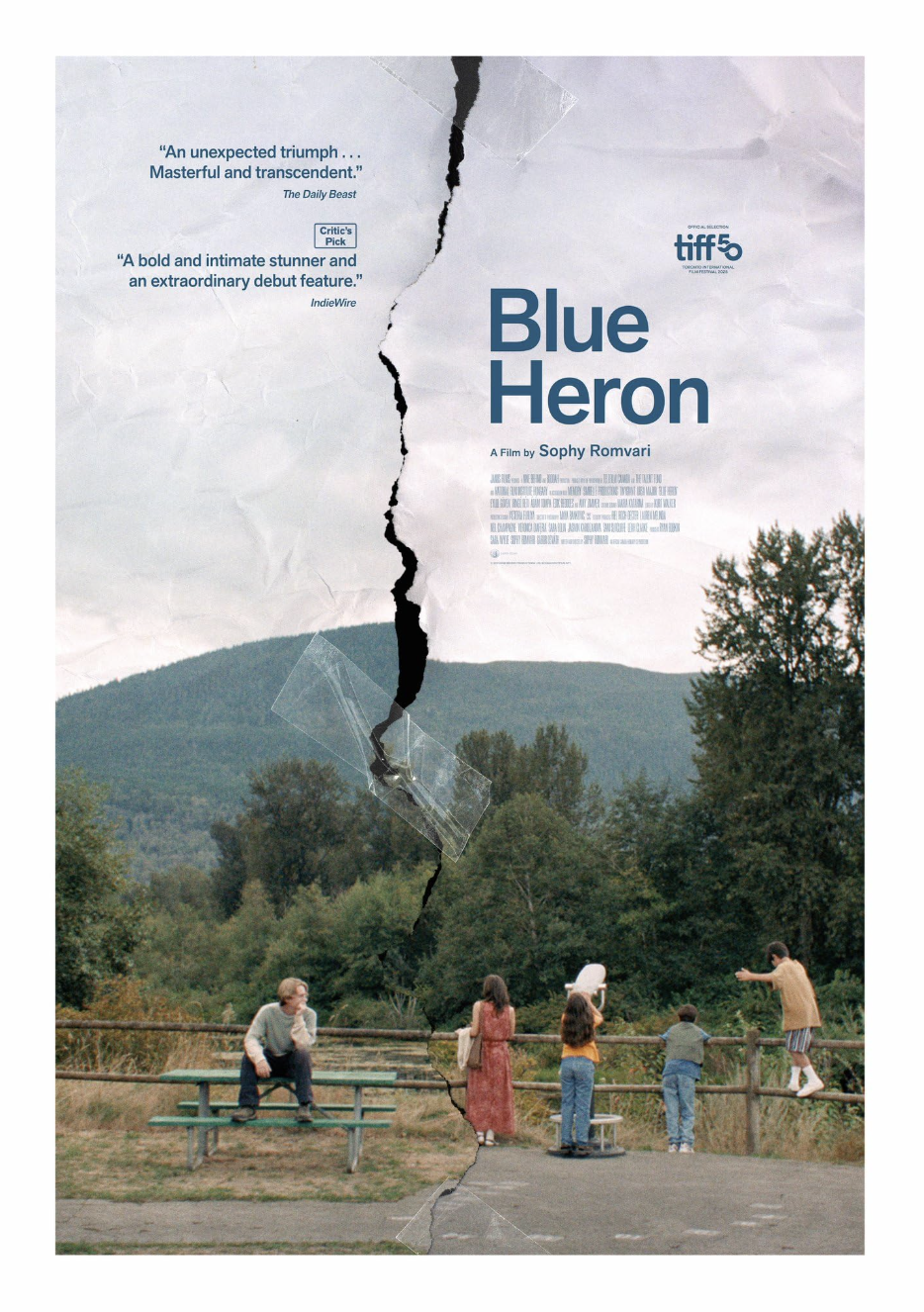
There is a question that haunts Blue Heron, the quietly devastating feature debut from Canadian-Hungarian filmmaker Sophy Romvari, and it goes something like this: what do you actually remember of your childhood, and what do you only remember because someone took a photograph? And if you pressed those two things together, the felt and the documented, the real and the reconstructed, could you build something true enough to finally answer the questions you were too young to know how to ask?
Romvari isn't interested in easy answers. She is interested in something harder and rarer: the texture of not knowing.
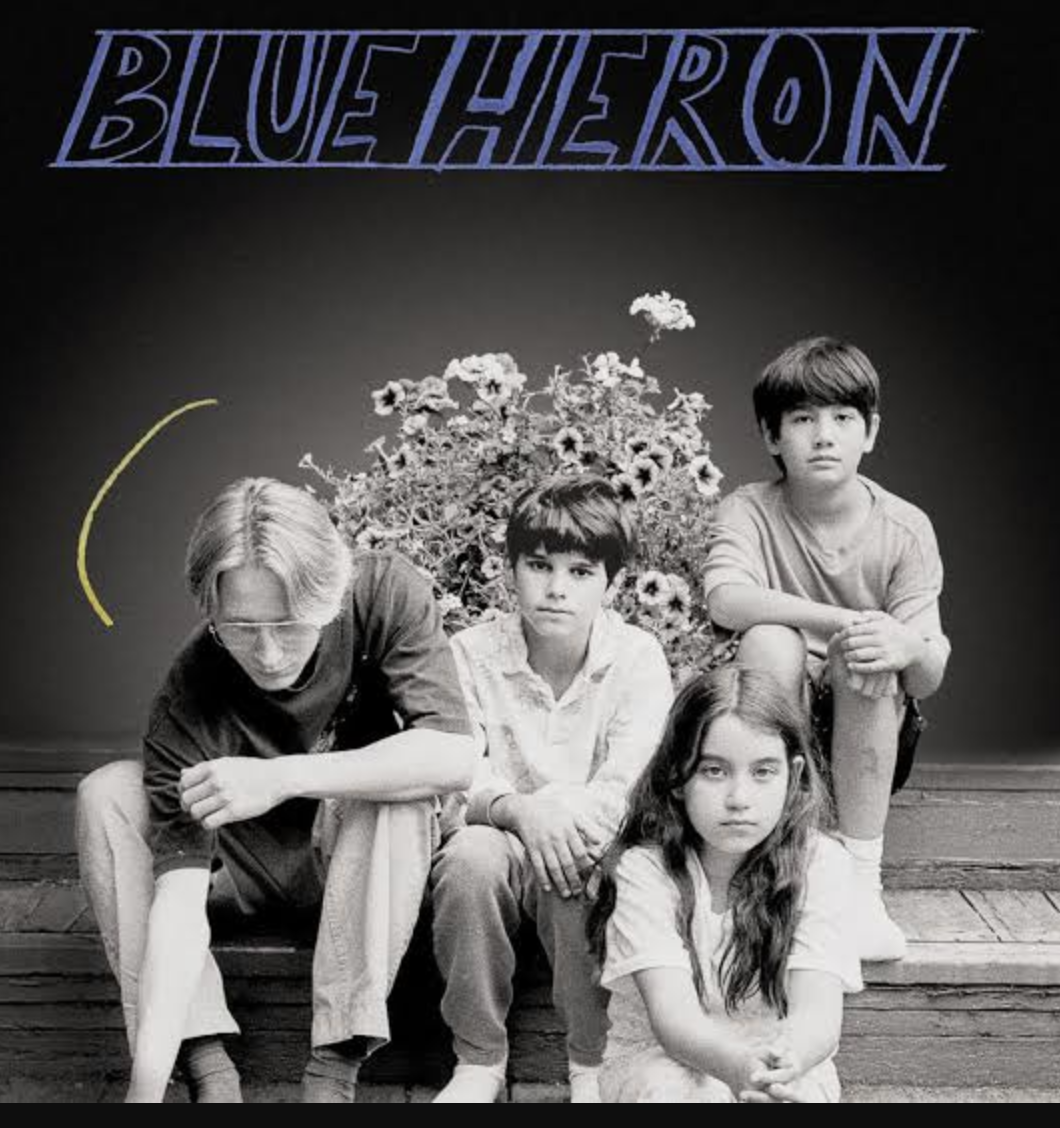
The film opens in the 1990s. A Hungarian immigrant family — three brothers, one sister, two parents — relocate to a new home near the coast of Vancouver Island. The landscape receives them with something approaching indifference. It is also staggeringly beautiful: the fog-dense firs, the pewter shoreline, the green-grey light that makes everything look slightly underwater, slightly past. Sasha, eight years old and the family's youngest, absorbs all of it: the new house, the new island, the old trouble that has followed them here.
At the edge of the frame stands Jeremy, her eldest brother. Romvari films him the way a child would: obliquely, in fragments, at the corner of the eye. We don't hear him speak. We watch, instead, the way everyone moves around him. Parental conversations end when small feet enter the room. Information arrives anyway, muffled through walls, competing with the television. Romvari understands something precise and painful about childhood perception: that children receive the things adults try to conceal. They just receive them wrong: sideways, partial, stripped of context. The camera obeys this logic faithfully. It watches from doorways. It lingers on the wrong side of glass.
But Jeremy is not only a source of dread. In one quietly devastating scene at the beach, a family outing he spends mostly apart from them, he mock-threatens to step on a small tower of stones and shells Sasha has stacked, then places a blue heron keychain on top of it: a shoplifted gift, offered without ceremony. It is a tiny gesture. In the architecture of this film, it is load-bearing.
Then, more than halfway through, the film shifts. Adult Sasha appears — now a filmmaker, now armed with the tools and the distance that childhood denied her. She is making a documentary about her brother's case, interviewing therapists and social workers, pressing the institutional record for the answers the past refused to yield. What she finds is that twenty years have passed and very little has changed. The options for families like hers remain pitifully few. The gap between what people need and what systems offer is still wide enough to swallow someone whole. There is a quiet fury in this section of the film that never announces itself as fury. It simply shows you the rooms. It lets you sit in them.
Blue Heron's most formally audacious and emotionally devastating passage comes when Romvari has adult Sasha imagine herself stepping back into her own childhood home — this time as the social worker conducting the very consultation she could only overhear as a child. To watch the grown woman occupy the authority she was denied then is almost unbearable. It is not catharsis. It is the discovery that understanding something fully, finally, does not mean you can change it.
Throughout all of this, the performances are extraordinary. Iringó Réti, as the mother, does something almost unrepeatable; she maps, with total physical conviction, the specific exhaustion of a woman who loves her child completely and is running, visibly, out of road. Young Eylul Guven, as eight-year-old Sasha, carries entire paragraphs of feeling without a single line of dialogue to lean on. She has the face of someone trying very hard to understand something she has been given no tools to understand.
Then, near the end, Jeremy speaks.
Sasha takes him to the beach. She reads him a letter written by someone who knew him during the years he was most unknowable to her. As she reads, something opens. He becomes, for a few moments, a person in full, with an inner life, with history, with a self that existed before and beyond the family's fear and grief. For a brief moment, he is entirely real to her and to us.
And then, because some stories can only end one way, he disappears.
This is the unbearable arithmetic at the heart of Blue Heron: that the answers sometimes only come too late to use. That you can do everything right: gather the testimony, make the film, drive your brother to the water, and still not be able to go back and change what happened when it was happening. Romvari closes the film with a Daniel Johnston song, “Some Things Last a Long Time,” and the choice is perfect: an artist who never asked why, who simply perceived and named what was in front of him. Romvari asks why, obsessively, from every angle. The film's terrible and tender conclusion is that the question may be the only answer available.
Blue Heron announces a filmmaker of uncommon emotional intelligence. It is a film about memory and mental illness, about institutional failure and family love, about the knife-edge between retrospection and grief. But more than any of that, it is a film about looking: looking back, looking carefully, looking at someone you love and understanding, too late, that you never fully saw them.
Some things are immovable. Romvari finds a way to make that truth not crushing, but luminous.
WATCH TRAILER
blue heron
DIRECTED BY Sophy Romvari
very laboratory