
The Conversation - Connor Tingley X Chaz Guest
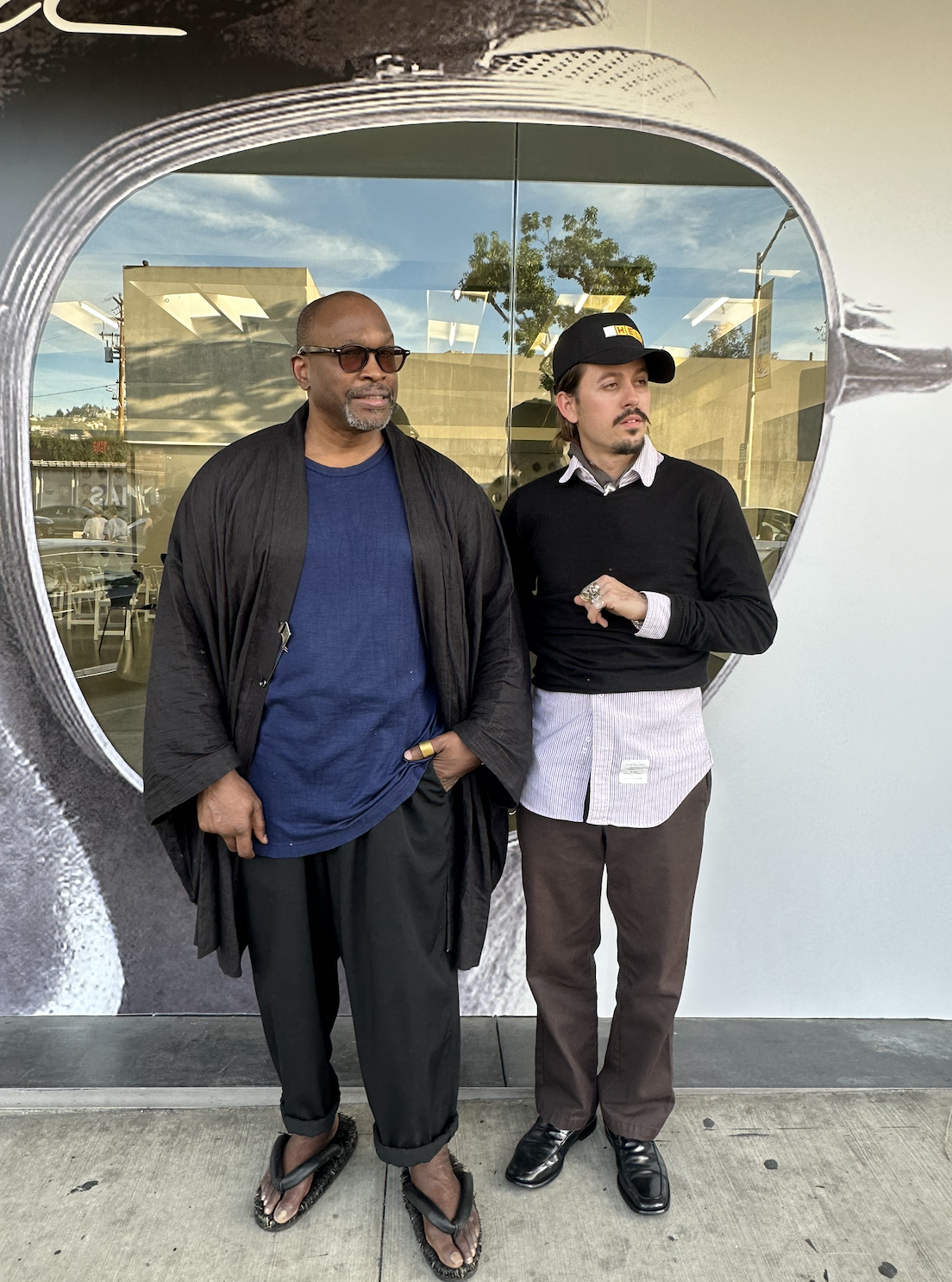
L to R Chaz Guest + Connor Tingley
THE LONG READ
THE CONVERSATION
CHAZ GUEST + CONNOR TINGLEY
IN PARTNERSHIP WITH MAXFIELD
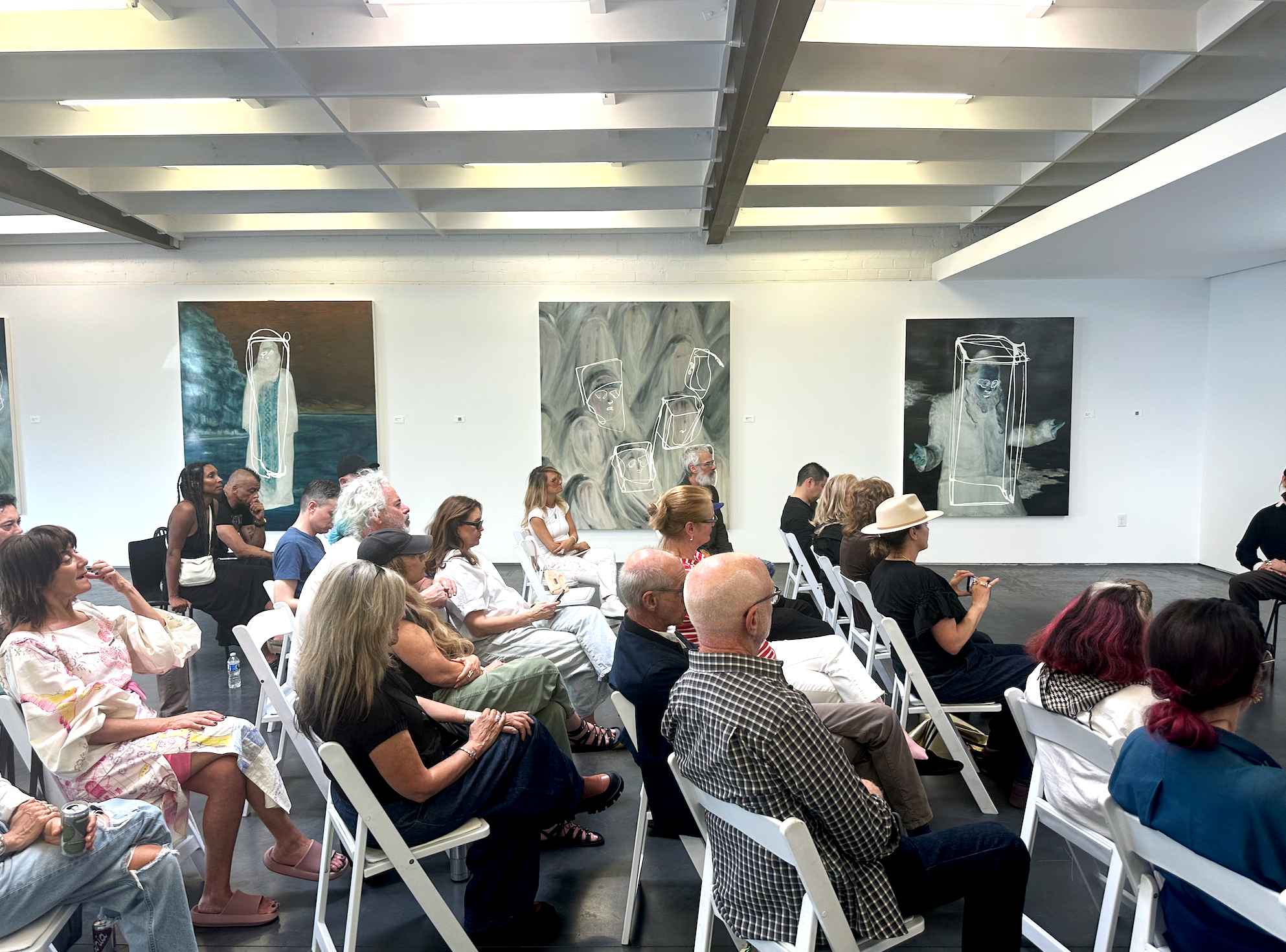
The Nun Series by Connor Tingley
This was the first time the series had been shown in public.
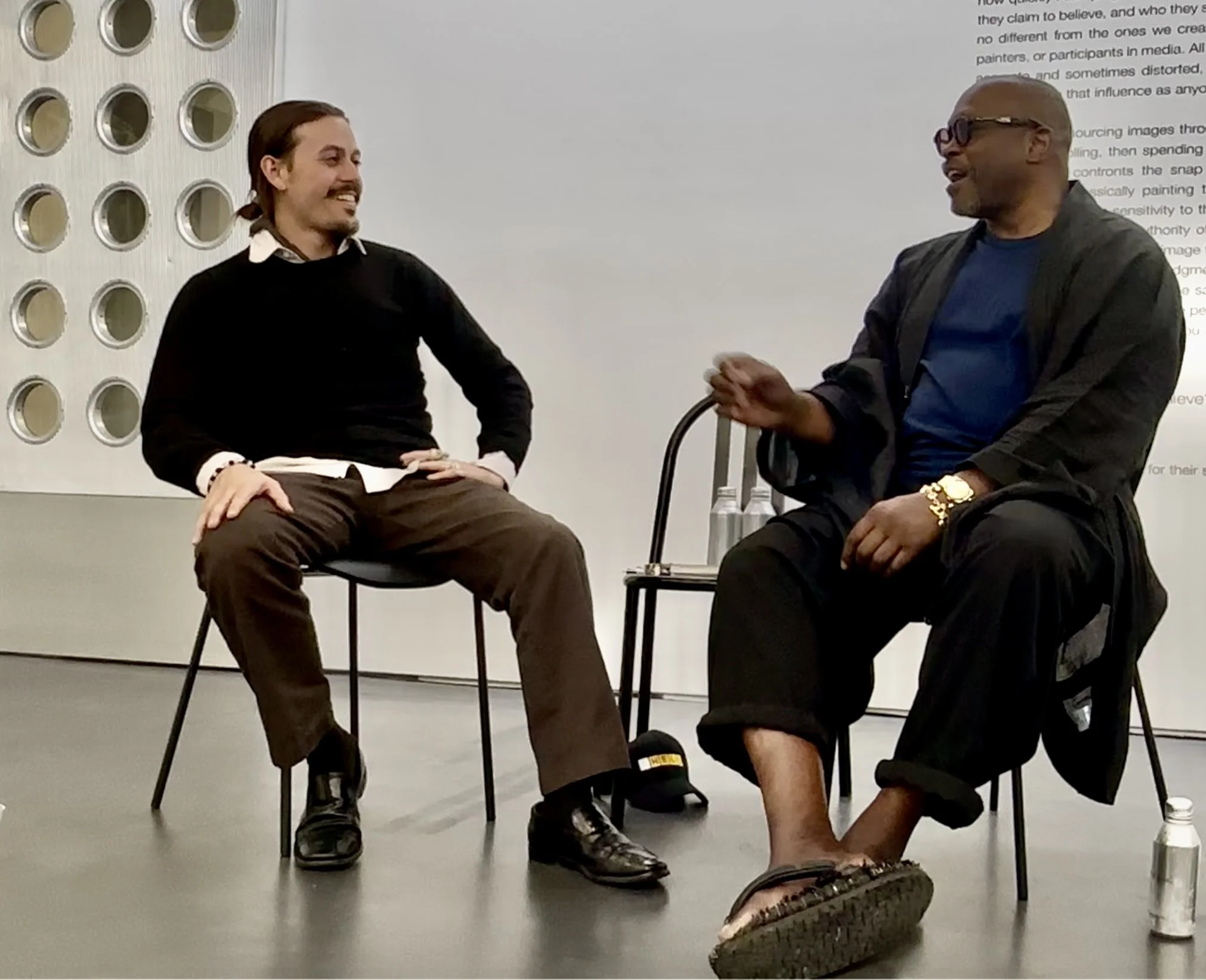
Artists Chaz Guest and Connor Tingley in conversation, discussing their process and the series with an invited audience.
Here is a transcript of their conversation that has been edited in moments for brevity and clarity.
THE LAB MAG
Today we have Chaz Guest and Connor Tingley in conversation. We are excited to have them in this space together, to talk about perception but also to look at the work that's around us. It's the first time they have met in person and the first time Chaz has seen Connor's work.
CONNOR TINGLEY
My main purpose is to serve as a point of inspiration in the most thorough, honest way. I'm very interested in the truth. I know that is a touchy subject, considering it often depends on where you're at in the world and who you're talking to. People have different foundations and different philosophies. The core truth that I'm always trying to get to is just reminding myself that I'm alive on this planet, and that is undeniable. We are all on this planet together. I think that becomes the new myth, and Joseph Campbell talks a lot about it. And Carl Sagan, these conversations really jarred humanity. I think that the ripple effect is still being had.
We need to settle on new philosophies, things that bring us together because we are together, and that's the truth. We're together on this planet. When I look at the work that I'm making, I always try to find that within what I'm doing. That's the conversation that brings me the most fulfilment.
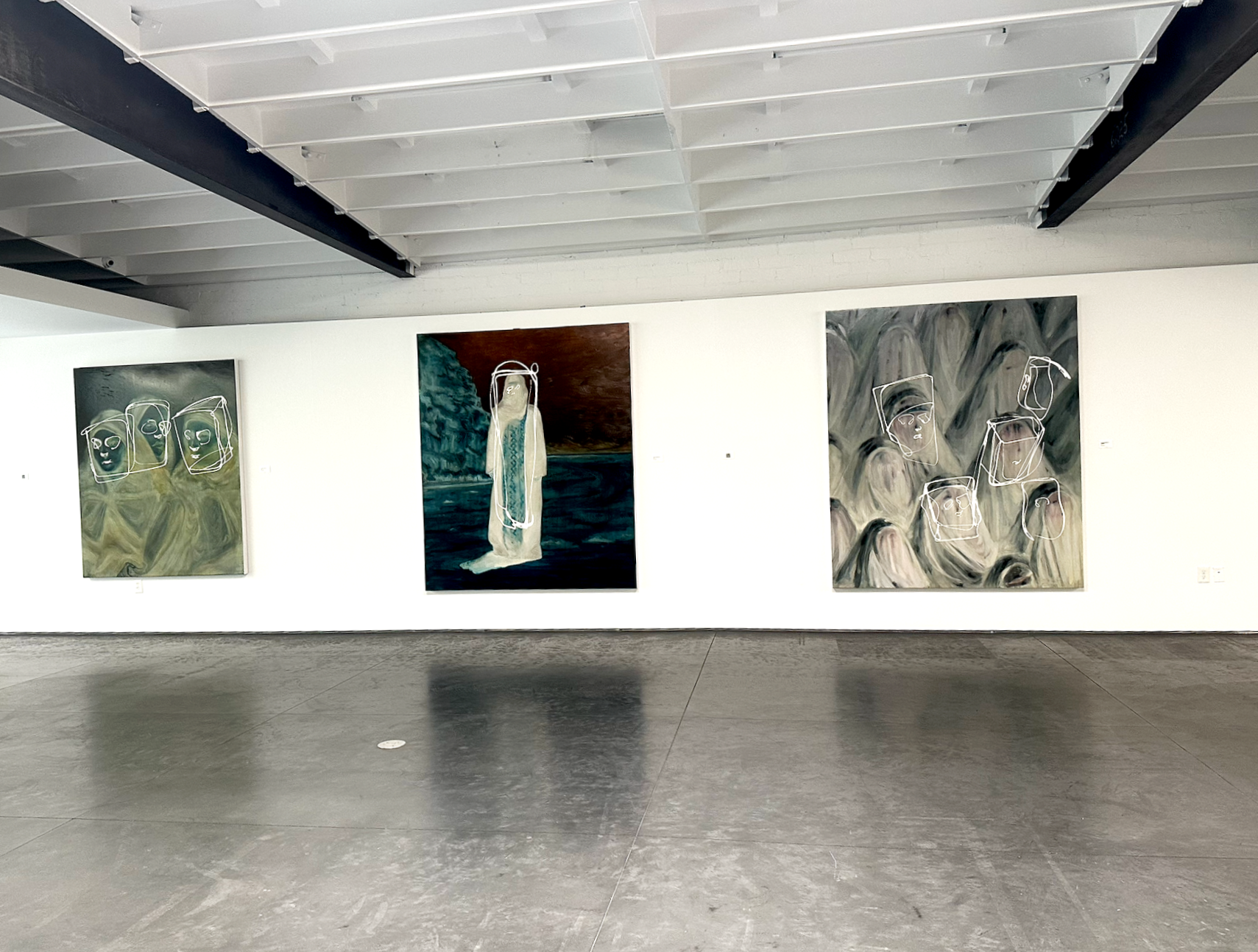
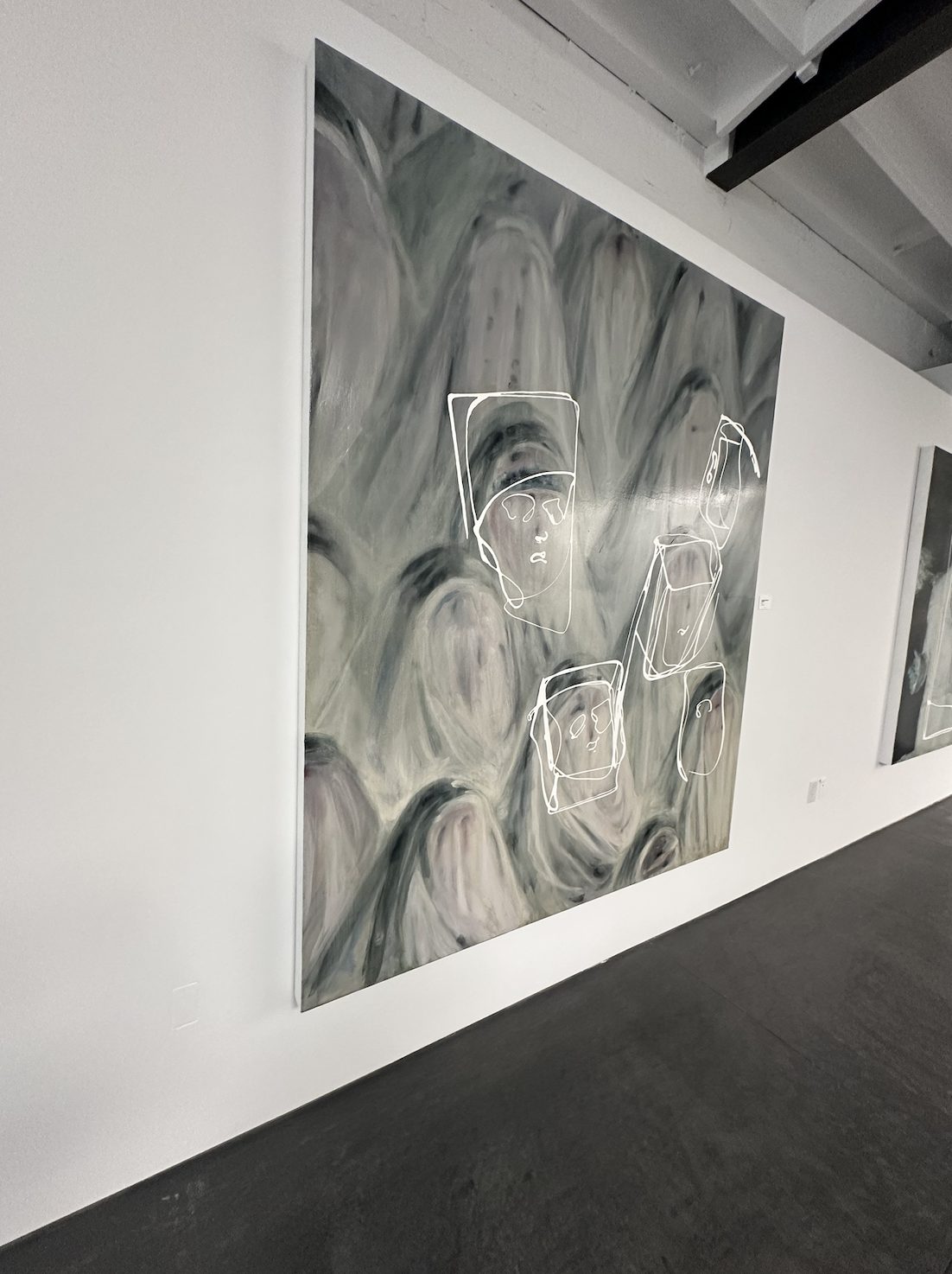
Chaz first asked me if these are all oil on panel, and then asked me how I painted them, almost like a process-oriented question. And then the first challenging question he asked me was why the white lines? Why the gestural markings? And I have to begin by saying that those gestural markings and those white lines go back to the very base layer; they go straight to the gesso. So that's a preserved layer. When I work, I think symbolically about making; I think the choices are always symbolic. When I look at these pieces, and I see the white lines, they're actually tracing my eyesight. All of these pieces started off on Google. The reference images are all from Google. That's why they're all titled what I typed into Google first.
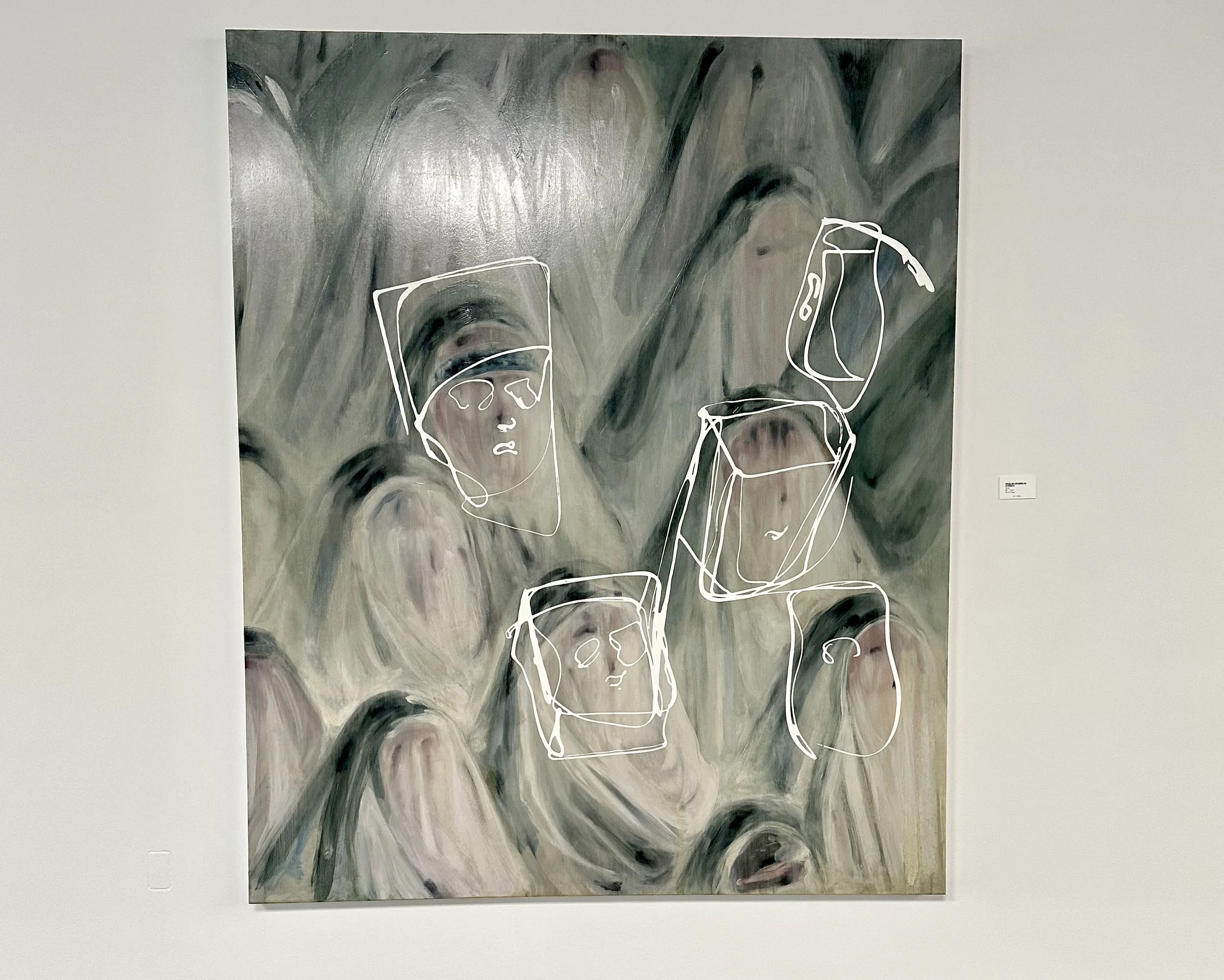
The Nun Series by Connor Tingley
We think about Google as this search engine, this library of images and information. And when we type something in, it gives us back information that supports the word that we typed in. So it's associating images with words, it's associating information with a word.
And the definition and the semantics of that word are provided to you with many different options. So I wanted to sit with my judgment and my bias. I wanted to even get into my own stereotypes and go, OK, I type in Catholic. I type in Muslim. I type in Jewish. I type in Christian. I type in Buddhist, Hindu. And I scroll, and I sit there in my emotions, and my feelings, and I see what image hits my sort of base sensibility. And once I see an image that I'm convinced by, I have to hold myself accountable for it. So these works are really a process of finding a way to keep the judgment that I initially had, to preserve that, whilst also undergoing a journey that's very personal to me.
I inverted the colour palette. Flipped the colour theory on its head. It’s like skating switch. It's a skateboarding reference. It's like walking backwards. I mean, you kind of have to relearn how to do it, how to paint, how to think about colour. But my main goal in doing so was actually to find a way to relate to photography because painting predated photography.
So when I look at these images that are now paintings, it's really interesting for me to think that, wow, these actually started off in Google, but now they are these scalable works on panel that are painted in this sfumato technique from the 15th century. And the reason why I wanted to do that was because I think in the late 1800s when photography came around, it really challenged painters and artists to go internally and I think that they were like well what are we going to do we've got photography coming out, representational painting is basically out the window and I'm sure a lot of them were afraid of their craft becoming obsolete but as artists always do you find a way. They went internally.
So I always thought about what the purpose of even knowing how to paint today. There are so many different ways to explore our imagination. What do we think about? There are so many different ways to work; we have Photoshop, and you have all these different mediums. Why paint?
CHAZ GUEST
Can I jump in right there? I'm going to forget if I let it linger.
CONNOR
Yes, of course.
CHAZ
I can hear generational differences, you know? And I think that's interesting in itself.
And the first thing I thought about when I did see your work right here is that you put on top what I put on the bottom. And so start from there. So I think it's very interesting when I look at the reverse concept of approaching art. But I want to hit on this before I forget. You said, why paint? This is interesting. Personally, and since I've been invited, I get to say my personal thoughts, and my personal feelings and thoughts are that I'm not attracted to Google or the computer. The computer stuff. And then why paint? Why paint is to hold on to what I see as truth. You see this as truth. Your truth. My truth is like cave paintings and on. That's the truth that I think should be expounded on forever. I don't think it should ever wane.
CONNOR
Right. I hear you.
CHAZ
You know, hearing how you come about arriving at your painting, it's a beautiful thing. It's beautiful, but it's very, very generational.
CONNOR
Yeah, sorry, I'm a product of my time.
CHAZ
And I think I'm going to share with you how I came about my process. I'll make it as brief as possible, and then let's see if it can be woven into what we're talking about. By the way, Carl Sagan, that thing that went up into space, the Voyager, that was in '76. I am way into Carl Sagan. Sometimes, to go to sleep, I imagine holding on to that satellite. I'm freaking like that. I mean, I'm a weird guy. I feel like I'm holding on to this, and now we're in interstellar space. I'm going to stop there.
(everyone laughing)
CONNOR
Cool, cool.
CHAZ
You see, it's very interesting. How I arrived, OK, here's what happened. I started painting in 1987, right? I had met Basquiat at Nells Club, and then I went to M.K., and so I was working on the wall. The owner of M.K., which is now the Bowrey Hotel, Basquiat was staying with his sister, Jennifer Good.
CONNOR
Was he staying with the sister of the owner of the hotel?
CHAZ
Yes, that's right. And so that's how I came across his works. And the first thing I saw, something said when I saw the work was, God, I wonder what it's like to be that free, in motion.
CONNOR
Oh wow.
CHAZ
Just have your brain rip. That was that thought. Now the other piece is that in my learning, in teaching myself how to paint, right, I had to go to the museums, and I would study Dali, Picasso, Gericault, you know, all of these people, and I would study them in a maniac kind of way. And so, therefore, what happens is that you start to imitate things that you like. You mentioned that, right? You start to imitate. And so my painting became very tight. Let me hurry up and get to the point. So, for some years up until 96 to 97, it was almost like, not imitating, but like really looking at something and really trying your best to find your own voice. But you're using this Dali painting, this Gericault painting or this Picasso painting as an extreme reference.
CONNOR
Right.
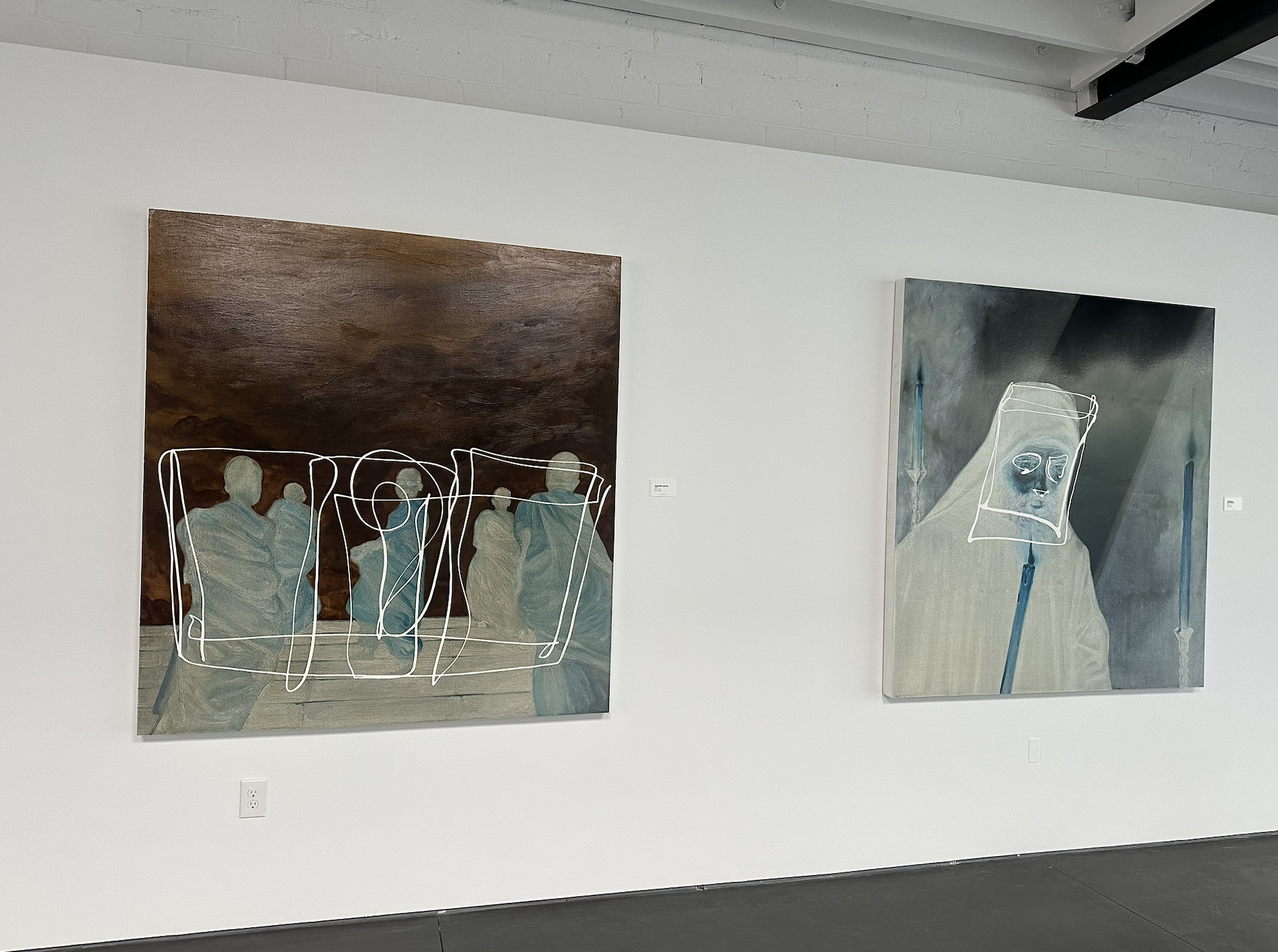
The Nun Series by Connor Tingley
CHAZ
But how I really feel, especially when I look at your work, is that I had entrapped myself into being a tight painter. I was thinking too much. You mentioned thinking too. So now my thing, because music teaches me how to paint, actually, and I heard Miles Davis say, "try not to think". Well, that was a trick. But that gift came to me from his saxophone player, Kenny Garrett, who invited me to paint on stage with his band in Tokyo, Japan. So here are two things happening. On my first trip to Tokyo, totally lost. Don't know anything about Tokyo. I just arrived there in 1997. Now I have to find The Blue Note. Now I have to figure out what I'm going to do. I never thought about creating a piece. But when I look at your work, and I see these lines, these lines, they're beautiful in their own way. And so, on stage, they announced the band, and they announced me, that I'm going to be painting. I said, I am? I mean, I didn't even think about that. Here's the not thinking part of the story and all of the Google stuff and it's kind of a beautiful story.
CONNOR
That's like a baptism by fire collaboration right there.
CHAZ
Exactly. They gave me what they call a fude. A fude is a Japanese brush. Right? And black sumi ink. I'd never touched this stuff. Not only that, I've got to paint something now. Never thought about it.
CONNOR
What a moment for you to just enter your dreams and immediately be free.
CHAZ
But I didn't want to be free; I was forced to be free. That's the thing about my story. My story is going to culminate in this. And they start playing, what the hell am I going to do? You talk about not thinking. Here's where everything shifts. Remember, I always teach myself from these types of paintings. I'm kind of envious of the way you can let loose like that. I'm going to ask you later what got you to be loose and free. So this situation got me to be loose and free with this newfound medium.
CONNOR
Just the moment of you being up on stage there and having to do that was just like... Was it like the school of hard knocks philosophy?
CHAZ
It gets interesting because I'm still locked. This is like my big brother throwing me into 12 feet of water in the pool. I couldn't swim. So it's like I had to create something with Kenny sweating, bobbing back and forth, playing the most incredible music you ever want to hear next to John Coltrane. I mean, they were going off. And I said, well, you've got to do something. I hitched onto that energy. And then started to create without thinking. Very lucidly. I thought of Basquiat at that time and the way he went off like that. And it turned into something organic. And in its organic nature, it looked like Marcel Duchamp's Woman descending the staircase, without thinking.
Is any of this coming together?
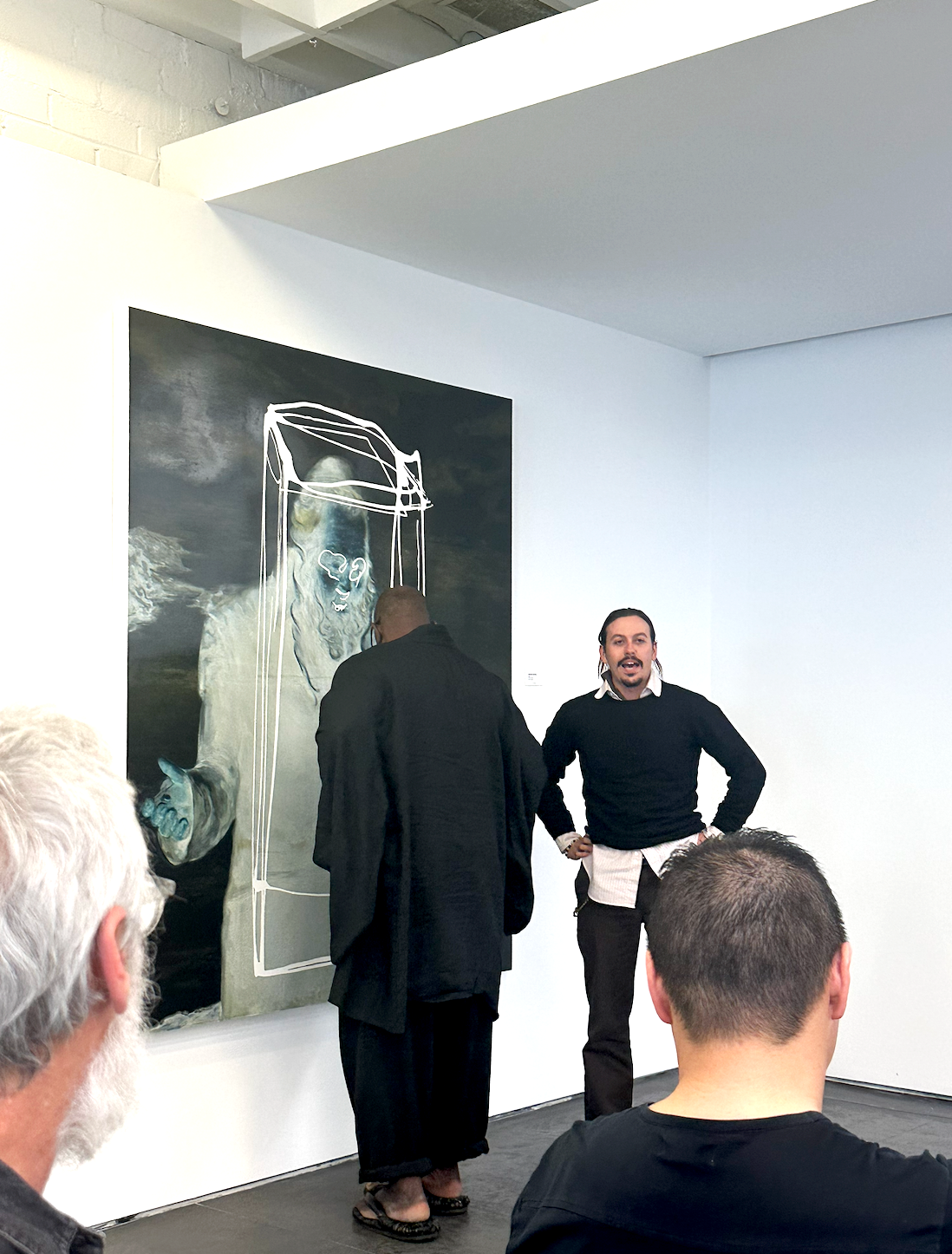
Chaz Guest & Connor Tingley
CONNOR
Yes.
CHAZ
OK, so now to this day, I almost have to force myself to just move, but I'm so attracted to giving you more inspiration and information.
CONNOR
Yeah.
CHAZ
It's very interesting.
CONNOR
I think it is a push and pull, and I really think that. It's very, very interesting.
I do think it comes more naturally to some people to just have almost no thinking, it's just feeling, and just sort of trusting that. Because they're doing it, it's going to happen, and they're there from one moment to the next. It's like a series of reactions. But yeah, I mean, that's a state of bliss. Sometimes it takes three hours of painting just to do one hour of painting.
CHAZ
But wait, say again.
CONNOR
Sometimes it takes just three or four hours of painting to do, really get into the rhythm of not being so overly thoughtful.
CHAZ
I mean, I've been painting now for 36 years, but it took me 36 years to get off my ass and make one line. It gets difficult sometimes. To go to the studio and make that first line.
CONNOR
Even on a blank canvas?
CHAZ
Well, it's never blank for me. It took 36 years for me to be confident to make that one first line. You understand what I mean?
CONNOR
Even to a blank canvas? That's freshly gessoed. I look at it and go, how dare I think that I'm going to ruin this perfect white canvas or this just perfect blank piece. It's almost like the audacity that I have to have, to do this.
CHAZ
That's also very opposite to my thinking. I can't wait to make a mess.
(Everyone laughs.)
CHAZ
Start figuring stuff out. You know, when I was in school, I was doing some math, which I still suck at. I was doing one thing and I remember the teacher walking up and saying Chaz, why are you doing it that way? That's got to be the most difficult way. I said that's why I like it.
CONNOR
Yeah.
CHAZ
I already know that. But how about this?
CONNOR
Isn't it interesting that there are certain things that come more organically to some people? Where do you think that plays into your childhood and younger development? The first couple of years, I would assume that there was like a base, you know, the first line of code?
CHAZ
Yeah, well, here's my friend Alexander. He's a magnificent cinematographer, right? And we had a talk a couple of days ago, and I said something to him as we were walking to my studio in my driveway, I'm watching these calla lilies just shoot up. I didn't even know I had calla lilies. I've been there for three damn years. "Where the hell did this calla lily come from?" And it was a whole bunch of them. It was a family of beautiful calla lilies.
And it just put me in the mind of how I'm envious of that. I'm envious of the fact that this seed is so connected to nature… I wish I could paint like that. I wish I could just move myself with limited information. So that goes back to you looking at a blank canvas.
CONNOR
Yeah.
CHAZ
My canvases are already done. I'm just waiting for the universe to give me the information needed for me to carry out a thought that I have, that I wish to share with somebody. Phewwww. OK, that's it. I'm exhausting myself. Go ahead.
CONNOR
I'll touch really quickly on something that a I'm sure you've also been asked this a lot of times, how do you know when it's done? I think each piece is really a conversation with yourself. For me, I think that's what's great about being in the art state of being, that you get to have your own philosophy because you're doing it your own way. It really is your journey of understanding yourself and because of that we're going to need different tools, different philosophies, different skill sets, different ways of thinking about things but when I think about somebody saying how do you know when it's finished, each piece is a conversation that I'm having with myself in the same way as when you're having a conversation with somebody in real life.
CHAZ
Or if you're in a conversation with yourself and you can't say anything else. I don't even care if it's applicable to someone else or whatever. That's what I want to say.
CONNOR
That's what it is.
CHAZ
And you're going to hear that for the rest of your life. Because that's what it is I want to say. But you mentioned your childhood and where it arrived at being me…
CONNOR
Your natural sensibilities, like how you approach something, so it might be more difficult for me or vice versa. There could be something that comes so organically for you, and I wish I had the ability to do it. You know, you think about Basquiat or something, it's like it might just have come so naturally for him.
CHAZ
Part of that is that I think it comes with age, because basically, I don't even care.
CONNOR
You're indifferent to it?
CHAZ
I just, don't care. That's where I am in my life. I just don't care.
CONNOR
That's a beautiful growth curve.
CHAZ
I'm doing my best because I want to. I want to say certain things because I want to. It's very me, me, me. It's probably very arrogant but I don't care.
CONNOR
But that's OK. I think it's a positive form of selfishness. It loops around.
CHAZ
To be a painter, you've got to be self-involved. I mean, you have to be so self-involved that it could be ridiculous. It could be more than ridiculous. That's just the fact.
But I want to tell you this short story because I think that I arrived at this creature that I am today from when I was a child. And I was fascinated with nature. And the great thing is that my parents left me alone. I don't even remember them saying it's dinnertime. You know, nightfall came, and then I'd go home. This is in Niagara Falls, by the way. This is before I moved to the inner city. And ants and worms and earth… and this was the beginning. I can say that I began to be gifted, as we all are as human beings, to have the ability to connect with the universe, and then many gifts come. We all have that as human beings. I noticed that very early as I'm digging for a worm, and I'm wondering how can you live in the dirt? and I'm asking some questions to the worms. I'm asking, Ants, where are you guys going? And there's a line like that, but what if I just interrupted the line?
(CHAZ gets up and acts out breaking the line with his feet)
Hey, can you fix that? Then I watched them fix it. Yeah, I was a weird-ass kid. Then somebody gave me some brushes and crayons. Let's see what he can do. So that's me as a kid. This is who I am right now. We don't change, we evolve.
Like if you were an asshole as a child, you're gonna be a bigger asshole.
CONNOR
Right.
CHAZ
Does that make sense?
CONNOR
Of course. It makes sense. I appreciate you asking.
(Laughter)
I just love that you cherish your childhood memories like that and that you see them as foundational and that you are stoked to share with people, because I really do think that those are very precious moments that happen before you start to perform.
I think we get to a place where we become self-conscious. Some people call it the age of accountability. And you get to a place where you start to be self-aware. And then because of that, you're at the fork in the road.
CHAZ
There's always this fork in the road and fortunately, I want to arrive at who I really am as this human being because I want to inspire the next group of human beings somehow. I hope that with the power and some talent that has been bestowed upon me, I can inspire the next group of humans coming in some way. That's my goal.
CONNOR
Yeah, I think that's the ultimate mission of an artist. And that's the purest, most legitimate reason for doing it.
CHAZ
I know, like myself, I know you have a lot of art books, right? Those guys are inspiring. Soutine, Romare Bearden, Jacob Lawrence, Picasso, on and on, Rodin, Leonardo da Vinci.
CONNOR
It's like all their works are a testament to their meditation.
CHAZ
Exactly.
CONNOR
I mean, that's why when I go to museums or if I go and see someone's show, even that can be inspiring. You say, " Wow, let me get back and just write a little bit, or get straight back into work", or whatever. Yeah, just get into expression and take my thoughts and feelings seriously.
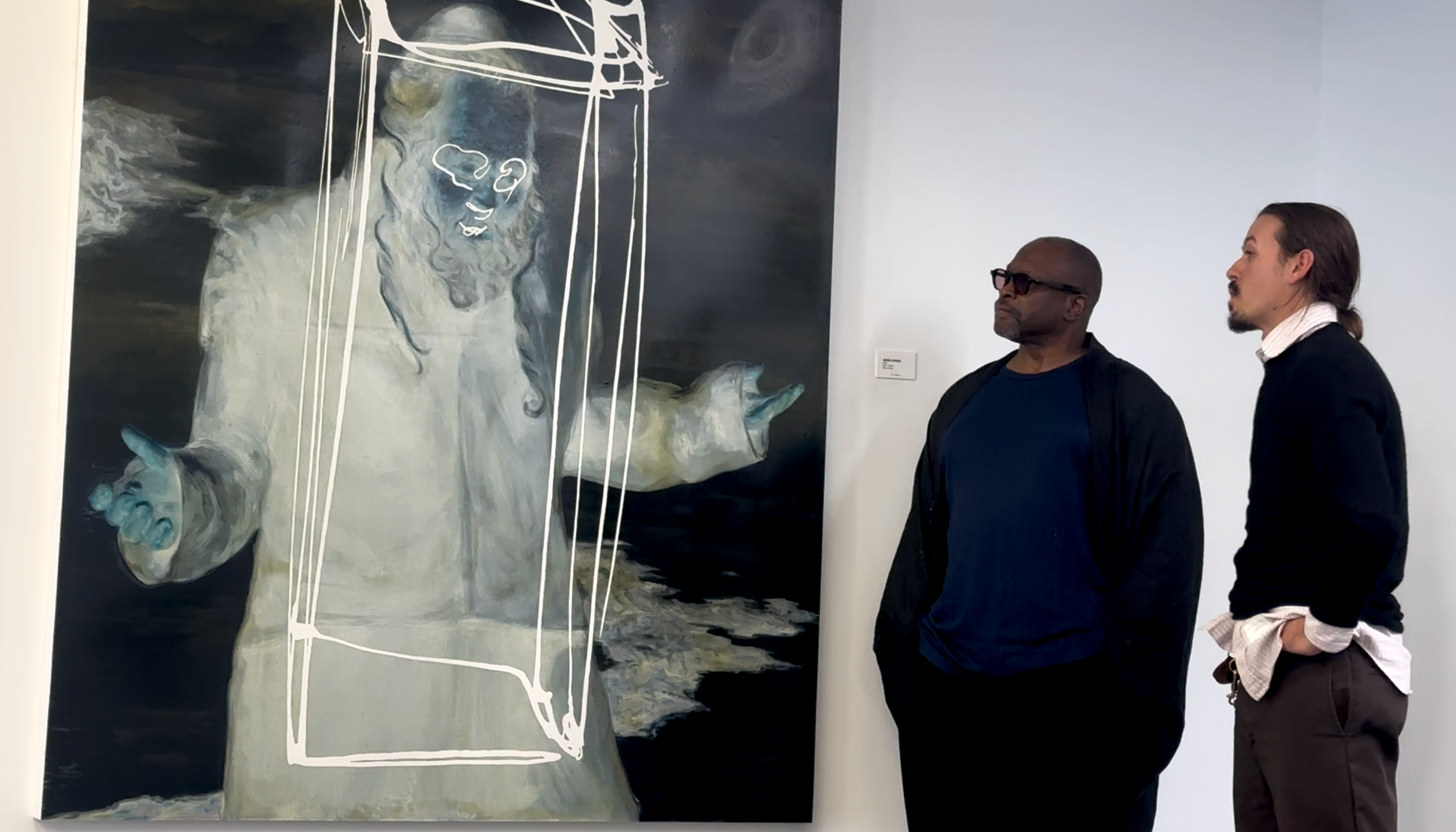
Chaz Guest and Connor Tingley discussing The Nun Series
CHAZ
Well, you're very talented. I enjoy your courage to approach this canvas the way that you do.
CONNOR
Thank you.
CHAZ
It reminds me of a time when I was at Julian Schnabel's house, and I had just come from my other friend's house, Emilio Cruz, I think he was 80 years old. And when I opened his door on Broadway… his work was so absolutely beautiful and powerful.
CONNOR
Emilio Cruz? I'm not familiar with him.
CHAZ
No, you won't know him. His attitude got in his way. He's passed away.
CONNOR
Were you just going to hang out?
CHAZ
No I was trying to buy one from his wife.
CONNOR
But he was in that circle, with Schnabel and those guys?
CHAZ
No, he hated those guys. No, no, no. He was in the circle with Bob Thompson. Do you know Bob Thompson? Well, you will now. Because you're going to Google it. OK.
(Much Laughter)
CONNOR
Yes sir.
CHAZ
Hey, I'm 65, I have to tell you that.
CONNOR
Yes, you do.
CHAZ
So, I used to hang out with this guy, and he talked about Robert Thompson a lot, but he always wanted to fight me. I think he was just envious of my youth at the time, but I thought, I'm going to knock this guy out, you know? He was funny. But Emilio was a genius. So anyway, one day I was hanging out with him, and we cooked some fish and hung out, talked and had a great time at his studio. Then I went to Julian's studio and my mind was kind of like twisted in a way, whereby, if anybody knows Julian here, he's a real talker, you know. Boy, he's a genius in many things, especially making films. Boy, he can really talk.
I'm coming around to your works…. I asked him, why did you swing that white across your painting? And from hanging out with someone like Emilio, to just hearing Julian say, "Well, I was turning pages when some glue or something stuck to the page and I turned it fast, and it ripped, and it put white on the image, and I thought that that was pretty interesting. So that's why I just went.. (mimes painting)", I said, wow, OK. Letting me into the process.
Like Jackson Pollock. I'm going to spill a little splash on the canvas, and then this door opened up. I mean, that's pretty damn cool. So we find ourselves getting to it, our expressions in some odd ways. You know, and so it brings me to this. I love the fact that you can look at your paintings that you put down first. And then you look at them, and you'll say... well, I'm going to trap a certain part of my painting with these gestural, quick, loose lines. It's very nice. It reminds me of a friend of mine, Titus Kaphar. Do you know his work?
CONNOR
Yes.
CHAZ
Titus does a little bit of that, too, where he can scribble out something, and then he'll make a mark on it.
CONNOR
So there is a process of defacing in these works. There is a process I'm working through here. So when I was a kid, I wanted to work at Pixar. That was my life goal. I wanted to make animated films. And so I trained for it. I trained classically, in the Italian style.
I started with drawings. I drew from 10 to 15 years old very heavily.
And you know, I studied chiaroscuro lighting, I studied perspective, I studied the figure, anatomy. I started life drawing at 10 and a half years old. And then at 15 years old, that's when my mentor changed me to painting, which involved using colour more.
So I have this very strong basis of training. And for me, it was always about breaking tradition. So these traditional values that I had, they became, and I don't mean to relate it necessarily to the box-like structures you're seeing in the paintings, but they became a box for me. It really did. These traditional structures of how to draw and paint, where I can basically explain anything that's on my mind, became...a bit of... When I saw very chaotic free work, I was like, I need to get to that. I want that because I felt like there was a glass ceiling in knowing how to draw and paint very well.
CHAZ
There's a glass ceiling? Really?
CONNOR
That I needed to break through, and I needed to almost loop around to go almost to a place where I...from my formal training, I felt like I was butting up against an edge.
CHAZ
Oh, that's it right there. I understand. The formal training is the thing. That's the key right there.
CONNOR
Yes, but I had, and I had that ad nauseum, and for me it was like I wanted to understand what these painters in the museums were talking about. Because for me, the painter that I had so much respect for, that was the most recent in history, was John Singer Sargent. That was it. The line was drawn for me. If you asked me who my favourite painter in the in the world of respected fine art and whatnot, I would say John Singer Sargent.
CHAZ
I don't blame you. I just saw it show up at the Musée d'Orsay in September, in October. I just saw it. And I knew his work all my painting life. But when you see it in real life, it is insane.
CONNOR
Yeah, He is incredible. He's so calculated about what he knows what he's doing. It's so loose. I mean, it's just...
CHAZ
He had a ring on one lady's finger, and that ring, when you look up close, was a dot. You back up from it, and it's the entire ring.
CONNOR
Yeah, that's what I'm saying. If you crop into one of these pieces, it's like an ultimate abstract expressionist work, just if you do a little crop.
CHAZ
Did you know how young he was? When he was painting, doing these incredible paintings? He was 24 years old.
CONNOR
Yeah, he was very trained. Very, very,
CHAZ
And now, you know, when you mentioned training, so, OK, so I just got a hold of, someone sent my Coltrane painting back that I created in 1990. And it was really crinkled up, right? It had cracked so beautifully. They even sell crinkle today.
CONNOR
Yeah. Do you use that?
CHAZ
No.
(Laughter)
So the crinkle, the thing that happened made me think of Turner's painting. I think in 1987, when I was in Paris, they had a Turner show at the Musée d'Orsay. Every one of his paintings cracked. It wasn't purposeful. Unlike you, I wasn't trained. So I had to figure this out for myself. And so I took to making my own rabbit skin glue. It took like 13 hours to make this rabbit skin glue; it is what they make drums out of in Africa and other places, too. But anyway, the rabbit skin glue, right? And so, I used that first.
CONNOR
Before the gesso?
CHAZ
Yes, I didn't even put gesso. Because I really love raw canvas.
CONNOR
Me too.
CHAZ
So when I started painting, I didn't know what the hell I was doing
CONNOR
Beautiful.
CHAZ
I was unaware of the fact, much like Turner, that nature makes rabbit skin glue breathe. Makes sense. Therefore, it started cracking. Thank God they invented PVA. That was a lifesaver.
CONNOR
But you know, it will with the humidity and time?
CHAZ
Yes. But not like the rabbit skin glue. So that rabbit skin glue actually cracked that Coltrane painting so beautifully. You'll never be able to do that unless you don't know what you're doing. Like, I didn't know what I was doing. And I have this beauty, not the subject, I'm not giving myself a compliment. I just love the cracks
CONNOR
Me too. Well, I think patinas take some time. That was a really good part of these works as well. Actually, on the top coat, where you see all that extreme gloss, which is in sort of direct conversation with his opposite, which is that blank area that's extremely matte.
But that top coat is gloss. People go, " Oh, that's a varnish." Not a varnish. It's an oil medium. It is basically what oil is cut with. And it is the most vicious material I've ever used. It takes 35 days to dry at a minimum. Bugs land in it. It is the most…
CHAZ
I'd use the bugs.
CONNOR
Yeah. I've picked probably 20 different bugs out of these pieces. Maybe with time and age, I won't care as much.
(Laughter)
CHAZ
Don't care.
CONNOR
So these pieces take about six to eight hundred hours to do.
CHAZ
Wow. You counted them?
CONNOR
I have a composition book where I write my painting time. And that's not counting drawing time. So they are all painted in the Sfumato technique. It's very thin washes of oil, and Sfumato in Italian means smoke, like smoke. So, there's 24 layers that's in there, translucent layers, not layers that are on top of each other, that are opaque. So it's like looking down into the Bahamas and the water where you can see all the way to the sand. You know, it's really about those washes being built on top of each other and that style was used by Leonardo da Vinci and his contemporaries. They would take walnut oil and cut the paint down so you had like 80 % oil 10 % pigment, and then they were just like, yep, that's right, so that they didn't have to mix the colour so perfectly. They could rely on the colour that was before and then just add a little hue to it. So these works were made with that process because I really wanted to connect these two different Renaissance periods. The 1500s, the height of representational painting, because it was like atmospheric with the style of Sfumato and then today, where you have images that can just be taken with a camera and done.
But let me get back to the patina look of it. This has that glossy look from that oil medium and it takes so long to dry. But imagine spending all that time on these paintings and then when I go and put the oil medium on them, I know that it's going to coagulate. It's going to get weird. You'll notice there are little black dots all over the pieces when you get close to them. Those are weird fibres from the air and they're connecting and welling up and it's like me sacrificing this work to whatever happens happens.
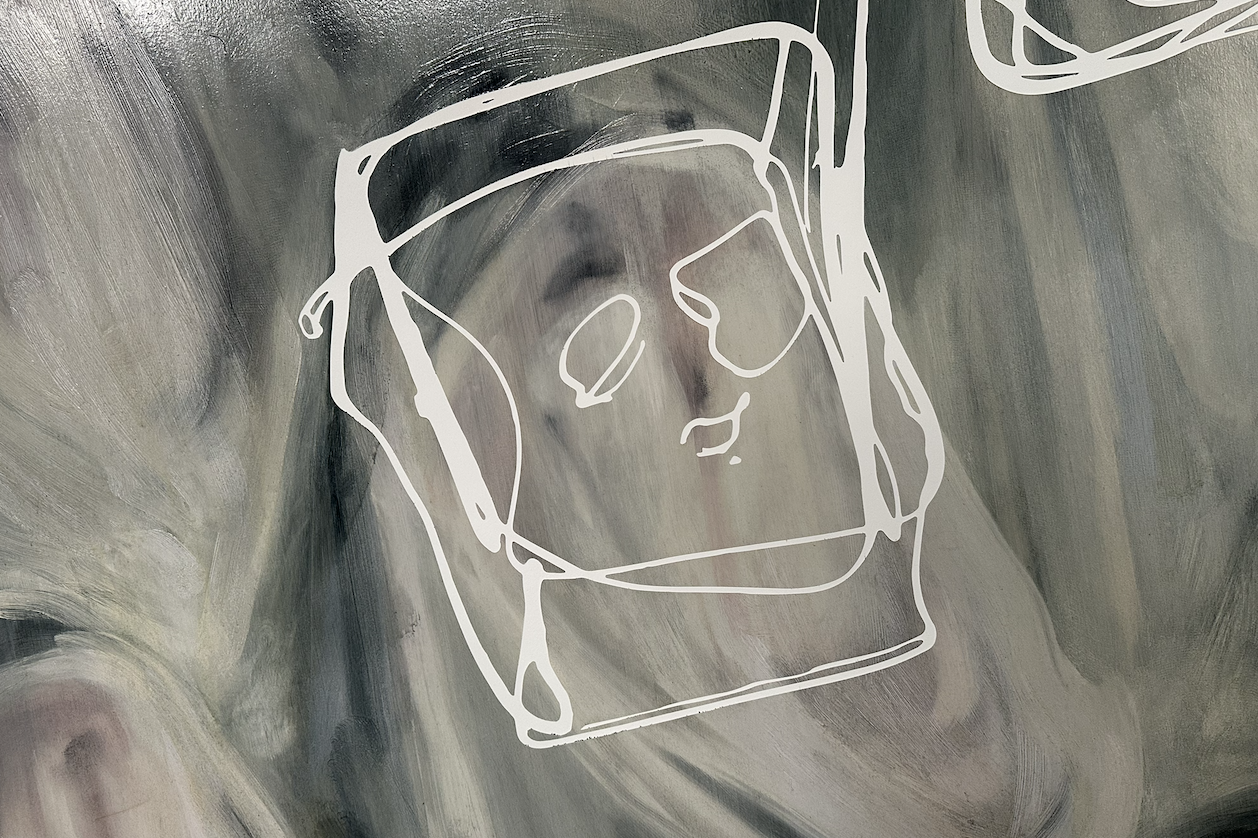
Close up of The Nun Series
CHAZ
Is that enamel? The white? The marks on the top.
CONNOR
That's gesso.
CHAZ
Oh, but that's oil, right?
CONNOR
The oil's on the top, the gesso's on the bottom.
CHAZ
No. Oh, so that's… OK so these white lines…
CONNOR
Let's go and take a look.
CONNOR & CHAZ LEAVE THEIR CHAIRS AND MOVE TO ONE OF THE PAINTINGS.
CHAZ
OK, so these lines are, they're… how in the hell did you do that?
CHAZ REACHES OUT AND TOUCHES THE CANVAS. CONNOR SMILES.
CONNOR (to audience)
I think Chaz is the only person that's ever even touched these...
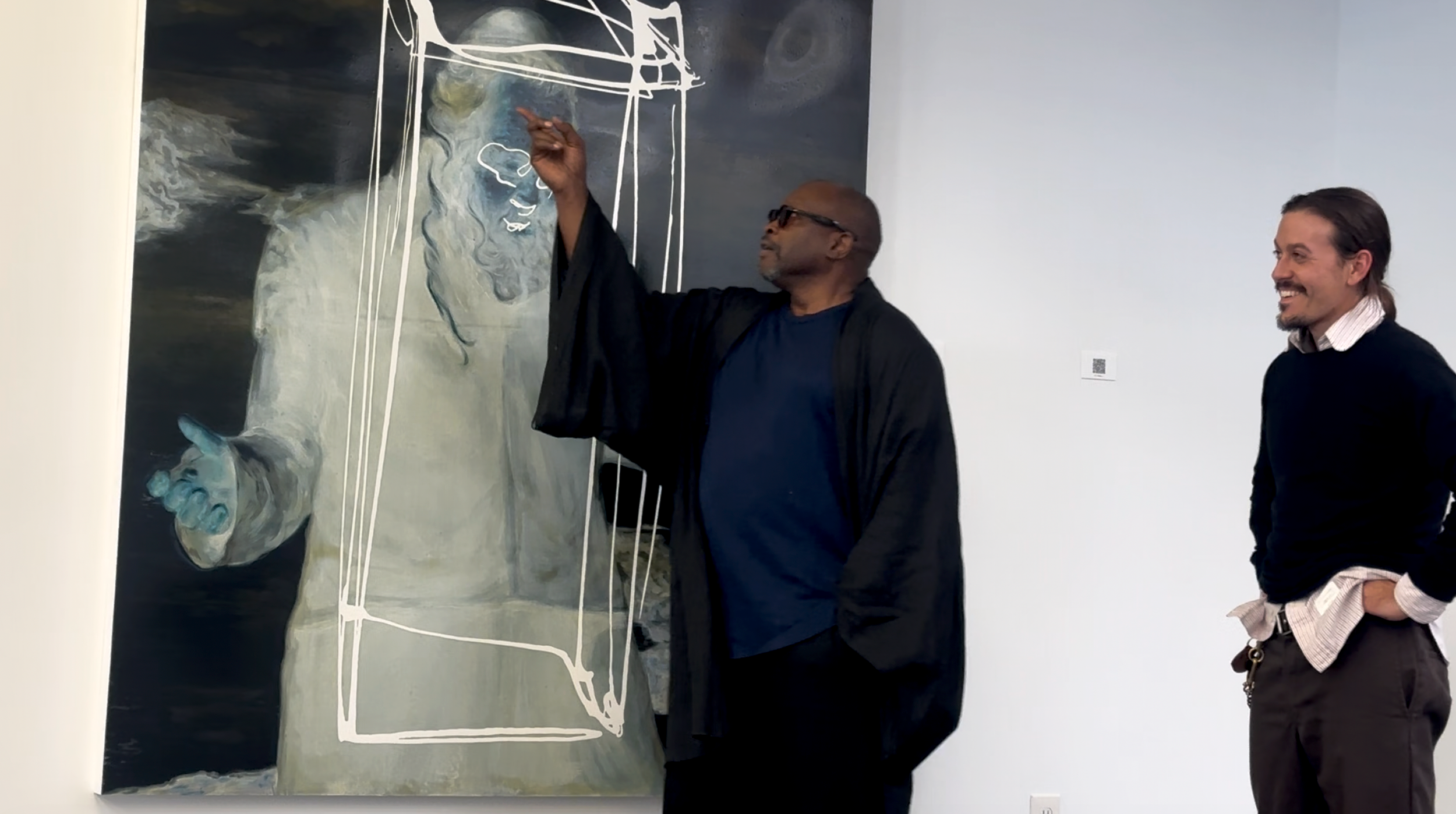
CHAZ
Yeah, yeah, yeah. Remember, I hung out with Julian (Schnabel).
THEY RETURN TO THEIR SEATS
CHAZ
Yeah, interesting. I'm glad that you showed me that.
CONNOR
So I'm such a believer in context. I think that context turns into like a metaphor. Like that being on bottom is very different than it being on the top. Because if it was on the top, then it wouldn't be serving as the first layer. And in these works, that white layer, I wanted to talk about what exists before any image.
CHAZ
That's really even cooler, man. I mean, it's sort of like, this reminded me of music, my first love, right? So this is very interesting.
CONNOR
So, with all of those white lines, that's a preserved layer. So imagine with all those white lines, I said these pieces take about 600 to 800 hours to do.
CHAZ GETS UP AND GOES BACK TO THE PAINTING, WHILE CONNOR EXPLAINS HIS PROCESS FURTHER.
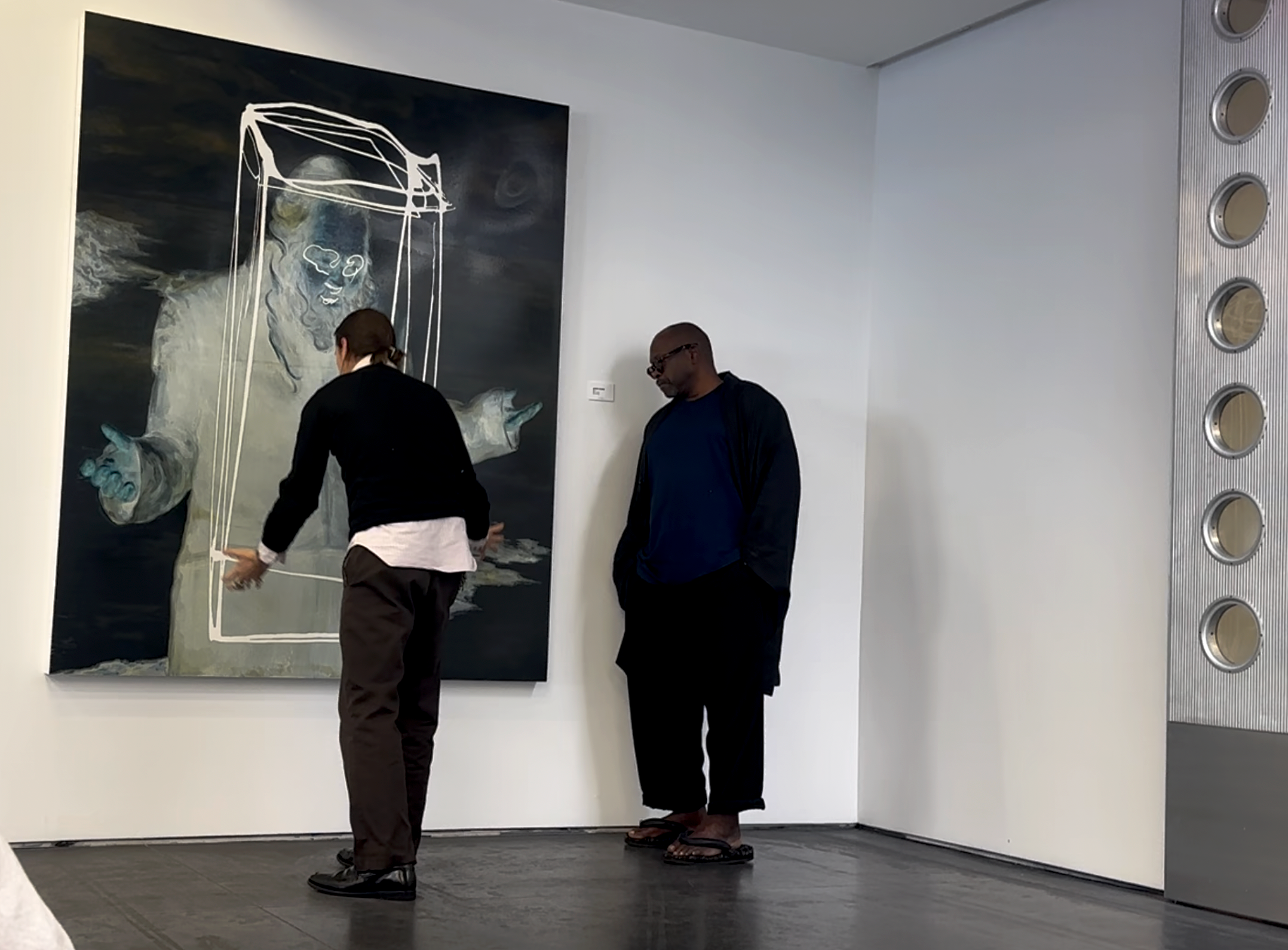
Connor Tinley & Chaz Guest in front of The Nun Series
CONNOR
With all those white lines, I have preserved and peeled up so many hours of painting. And I get to almost effectively renew this work and almost set it free. Because I'm painting over that, I'm not avoiding the lines.
CHAZ
But do you use a mask and then you rip it off, you take it off after?
CONNOR
Yeah.
CHAZ
OK, that helps me a little bit. But I think that you have something really nice going on. Do you make these works available to people?
CONNOR
Yeah. The works are going to be available in the future, but right now they're all in the hands of one collector because I want to show them all around the world.
CHAZ
OK, well that's brilliant.
What kind of brush do you use?
CONNOR
Have you ever heard of that place Nova Color?
CHAZ
No.
CONNOR
They sell acrylic paint. They've moved around a few times. They're specifically an acrylic paint maker and they have these brushes called Robertson brushes there and they're just like round brushes. I took the Sfumato technique to this other place when I was initially painting it. So, in the 1500s, the Sfumato painters would do all of this layering. But today, when I was painting these, I thought, well, I was using a brush quite often, but then I realised I can pack a microfiber cloth with more cloth, and I created this pounding brush that basically represented follicles of skin. You know how microfiber cloth is? So I was painting with that and then it was almost like these little moments in layering that were happening. You know what's another thing I want to show you about the work…
CHAZ
You made me think of Ang. You guys know the painter Ang Kiukok? Yeah, the way he painted flesh, with your skin colour. And I want to learn how to do that with my colour skin. That's the way you've got to approach that smoothness. What did you want to show me?
CONNOR
Yeah, so you can see traces of the microfiber cloth right here. See that there. See that?
So I contoured it, like this, it's almost like doing makeup.
CHAZ
Really?
CONNOR
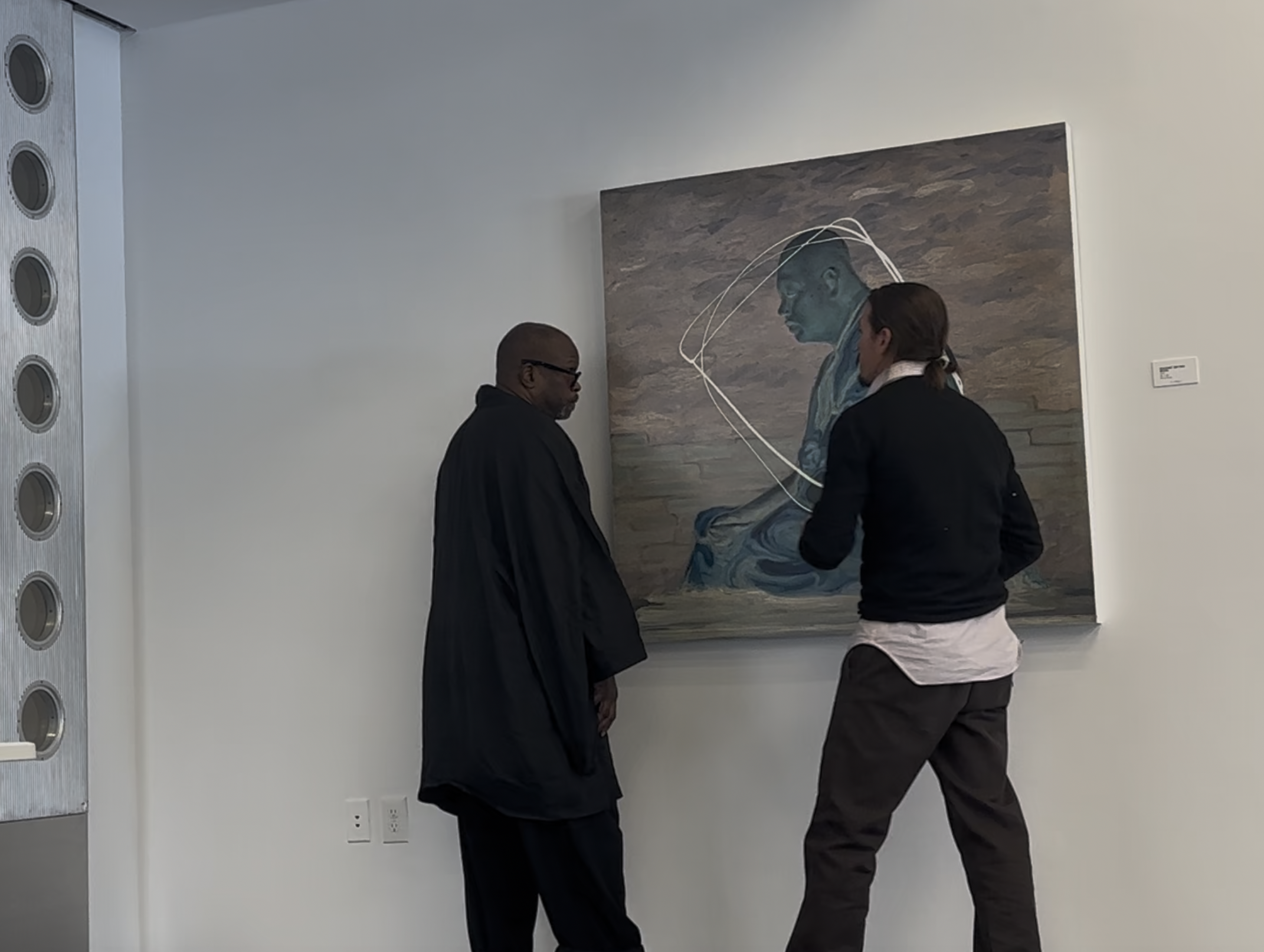
So how all of these images started on google, I found them from typing in this word right here.
CONNOR SHOWS CHAZ THE TITLE CARD NEXT TO THE PAINTING
CONNOR
This one specifically. I type in this one over here. Buddhist. This one over here, I type in Catholic. Then, when I find the image, I hold myself accountable to it, and I paint it at scale. But I'm painting it in photonegative.
CHAZ
I don't know what that means.
CONNOR
This is an inverted colour palette, so if you're looking at a black and white negative, they're just reversed. Black becomes white and white becomes black.
CHAZ
I got it.
CONNOR
So light becomes dark, dark becomes light.
CHAZ
I see. That's smart. Look at the big brains on Connor.
(Laughter)
CONNOR
Well, the purpose of doing that is so that I can have this image that I was so convinced by, which almost falls back into mystery.
CHAZ
I like the way you went about this one. This is not projected, this is freehand?
CONNOR
Yes
CHAZ
You did that very well. I really like this one.
CONNOR
Yeah, it turned out well. So, Chaz, the whole thing is now these images on my phone, they are returned back to the phone. And I know you're not a fan of technology. Me neither. If you think about it, paintings back in the day influenced people because they connected an image to an idea. I think today we're so programmed, more than ever. We're inundated with images, we're losing our sensitivity and the images that come in, we accept them as truth, and I think that this process of undergoing and making this work was really about me undergoing that process of not being sensitive to something, to spending time with it, letting it fall back into mystery and becoming sensitive again. So all of these images return to the phone. The phone, as this very toxic device, becomes a viewing device for us to see the images anew, that we were once so convinced by. If you have your phone, I'd love to show you.
CHAZ
That scares me a little bit. OK, I'll let you show me. It's really funny, because if I see an image on my phone, if I'm not near any other references, like say for instance, if I find a beautiful photograph by Gordon Parks, from the 50s or the 60s, on my phone. I will look at that picture sometimes, and this is the way I use this, then I want to paint what happened five seconds before he mashed the button. And that will become a painting. See how far away we are in our approach?
CONNOR
Wow. Our way of approaching is fascinating. It is really fascinating. It's like the more time I spend being an artist and making art, I think that the rest of the world categorises artists as one layer of society. But I think within that, there's just so much difference. Alright, buddy, I gotta show you this.
CHAZ
Show me….
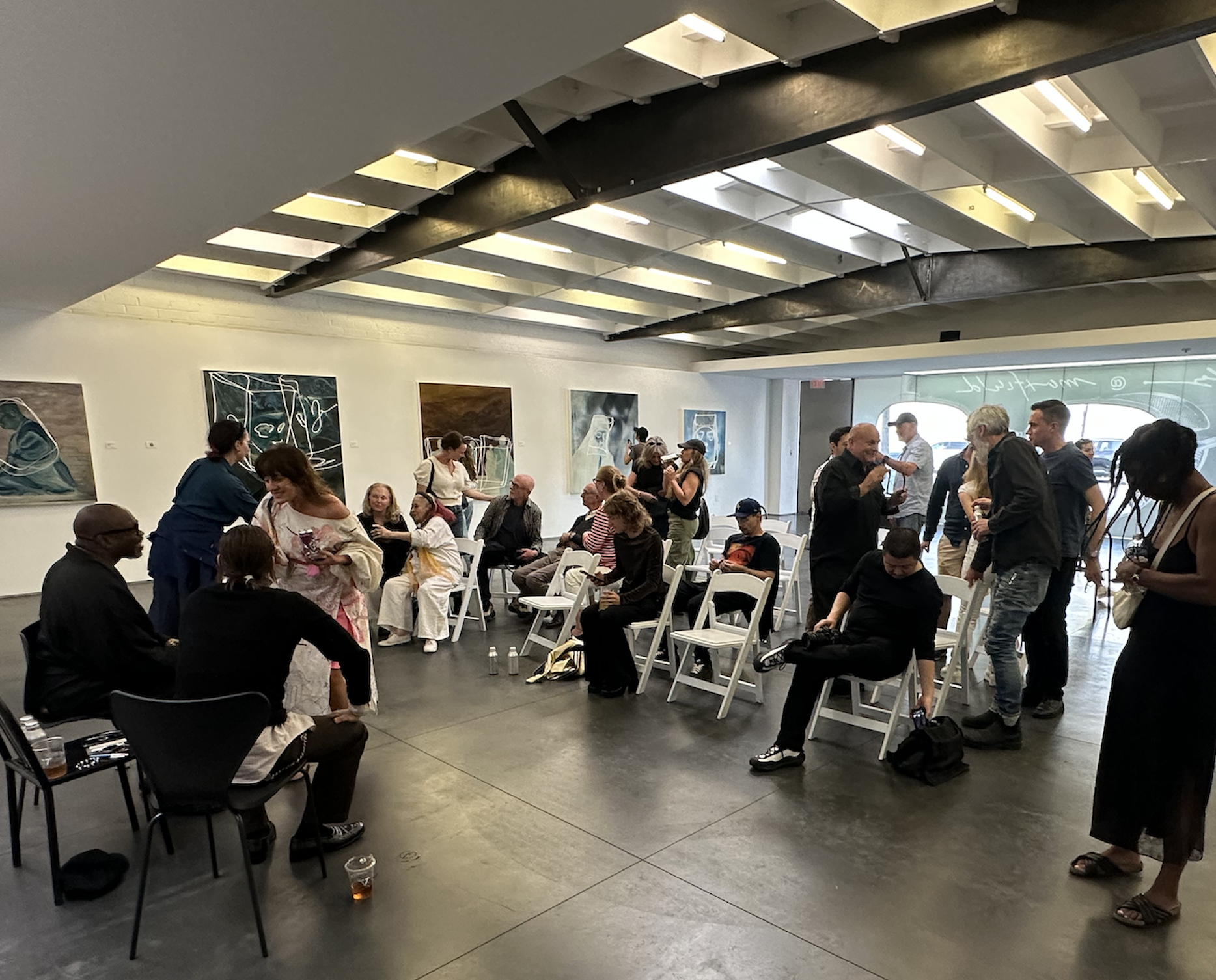
CONNOR AND CHAZ VIEW THE SERIES USING THE IPHONE TO REVEAL WHAT LIES BENEATH WITH THE AUDIENCE
******
The Nun Series by Connor Tingley was on display at
MAXFIELD GALLERY as part of FRIEZE 2026.
FUTURO VOL 2 featuring CONNOR TINGLEY
available for purchase
at MAXFIED, LOS ANGELES

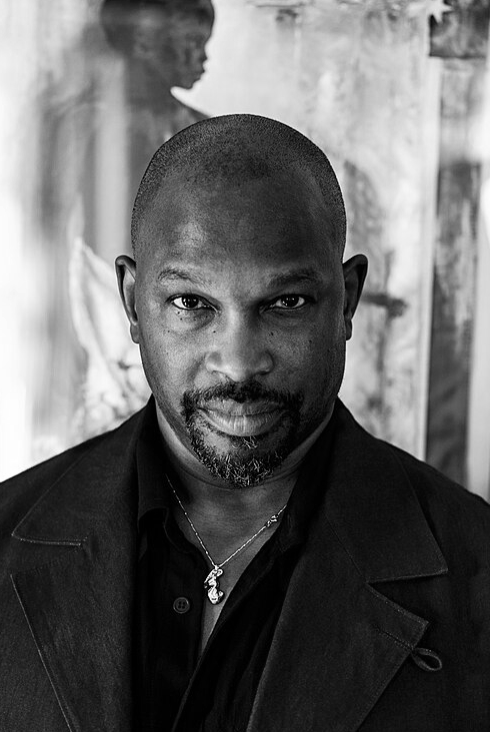
Photograph by Mark Hanauer, courtesy of Chaz Guest
CHAZ GUEST
Born in Niagra Falls NY; he is the seventh of nine brothers and sisters. After earning a Bachelor of Science in Graphic Design from Southern Connecticut State University, he then graduated from the Fashion Institute of Technology in New York. After graduating, Chaz moved to Paris, France. He worked for the fashion magazine Joyce, where he illustrated the lines for various haute couture houses.
Spanish philosopher George Santayana said, “Those who cannot remember the past are condemned to repeat it.” Artist Chaz Guest paints to remind us of our past and in so doing asks us what we would like our future to be.
Photograph by James Minchin
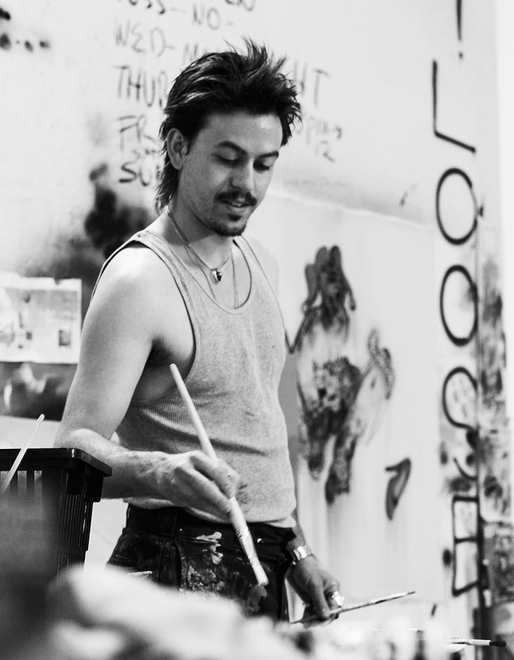
CONNOR TINGLEY
Connor Tingley is without doubt one of the most exciting artist’s practising his craft in Los Angeles. His dedication to authenticity led to the astonishing NUNS series. His self interrogation on the meaning of judgement and the notion that implicit biases are baked in, is paired with his astonishing abilty to put paint on canvas. He may use the 15th century sfumato technique but this series is layered with a very modern application. It activates using your iphone.
Oh and if inventiveness and thoughtfulness weren’t enough, he’s also a really good skateboarder.
*****
very laboratory